HOME        |        ABOUT        |        COPYRIGHT        |        CONTACT        |         RECIPE INDEX        |         INDIAN THAALIS        |         MILLET RECIPES        |        EVENTS' ROUNDUP        

Showing posts with label Coconut. Show all posts

Friday, February 11, 2022

Brown Rice Flour & Vegetable Rotti

 
Rotti is a staple of Karnataka cuisine and these unleavened flat breads are usually prepared using rice flour or finger millet flour or sorghum flour. Jolada rotti / Sorghum flour rotti are a specialty of the North Karnataka region and they are commonly eaten for meals there whereas akki rotti, the rice flour based ones are commonly prepared through out the state with variations. These akki rottis are frequently eaten as a breakfast at homes and they also become convenient lunch box item for kids. ('Akki' is rice in the local language). 

I replaced a portion of white rice flour with brown rice one in these rotti to make them healthier. (The brown rice flour I buy at 'Whole Foods' is not very fine ground and so need some regular rice flour to bind the dough.) Rotti can be kept simple with the addition of green chilis, salt, onions and coconut, which are called masale rotti in some parts. Or vegetables can be added to add nutition. Fenugreek leaves can be substituted with amaranth or spinach leaves. The combination of veggies I have added here, especially the cucumber helps in keeping the rotti softer longer. 

The dough can be prepared the previous night and refrigerated which saves time during the morning rush. The dough can be taken out and used in the morning even without thawing. The rottis can be made thinner than what I have made here. Each rotti takes less than 10 minutes to make and doesn't even need constant supervision. One standard tawa / griddle sized rotti would be sufficient if packing a kids' lunch box. These rotti do not need any side dishes in general. They are served with jaggery or some chutney pudi (for older kids / adults), which are staples in any south Indian kitchen. 

Ingredients: (Yield - 5 rotti)
1 cup brown rice flour
1/2 cup rice flour (Store bought can be used.)
Salt to taste
1 carrot
1 small cucumber
1/4 to 1/2 cup fenugreek leaves / methi leaves
1 or 2 green chili
1/4 to 1/2 cup shredded, fresh coconut
A handful of cilantro leaves, finely minced
Oil to make rotti


Preparing the dough:
*
Peel and grate the cucumbers. If the cucumbers are not tender, quarter them vertically, remove the seeds and then grate.

* Peel and grate the carrot. Wash and roughly chop the fenugreek leaves.
* Chop green chili very finely. (Green chili can be pulsed with  coconut in a food processor / mixer without adding water, to avoid biting on them. This method is helpful, if especially cooking for kids.)
* First combine the flours and salt in a mixing bowl. Then add all the other ingredients except oil in a mixing bowl.

* Add water as needed to form a firm dough. The rotti can be made immediately at this point, following the below method. Or the dough can be refrigerated in a container with a tight fitting lid. Plan to use the dough within a couple of days.
 
* Divide the dough into 5 equal portions. Work with one portion at a time and keep the rest covered. Shape one portion into a ball.
* Pour a tsp. of oil in the center of a griddle / skillet you are going to use to make rottis. Place the dough ball at the center of the griddle and pat with your fingers till you form a thin, flat circle. (There is no need to make it super thin like pancakes.) The rotti size depends on one's preference. Some prefer to make it griddle sized and some go with smaller ones. Poke a hole in the middle with your index finger if you wish or just leave it out.
 
* Pour a tsp. of oil around the edges of the dough circle and over it. Cover with a lid and turn on the stove. Let it cook on a low - medium flame and flip it when golden brown spots develop on the bottom side and the upper side doesn't look raw. It may take around 5 to 6 minutes. 
 
 * Add 1/2 tsp.  of oil around the edges again if needed. Cover it again and cook for about 3 -4 minutes or until the other side turns light brown too. Turn off the stove and remove the cooked rotti with a spatula.
* Repeat the above steps with the remaining dough balls. However be sure to turn off the stove and cool the griddle before using it again. If in a hurry, the hot griddle can be held under running water to cool it down quickly. Or simultaneously 2 griddles can be used to quicken the cooking process.
* Rotti are usually served with chutney pudi. Some even serve with butter or yogurt, especially ragi / fingermillet rottis. When serving kids, they go with a combo of jaggery and ghee. The latter combo remains my favorite even though I am no longer a kid. :)

This is going to be my contribution to this week's Blogging marathon, with the theme 'Quick Breakfasts'. Check the page link to see what other marathoners are cooking.


Comment

Friday, November 26, 2021

'Quinoa' Maavinakayi Chitranna / Mango - Coconut Quinoa


(This was originally posted on 5 /3/2011.)

Quinoa can be incorporated into Indian cuisine effortlessly. It can be used to replace rice in most of the dishes that need it and this post happens to be one such recipe. Mango chitranna / pulihora is a simple yet delicious dish from South India that uses rice and green mango. It is prepared especially during summer times when green mangoes are available in abundance. I have replaced rice with quinoa in this popular, tongue- tickling dish and here is the method.
And don't worry about the long list of ingredients mentioned. Most of them go in the tadka / tempering.

Below are some other quinoa based dishes that I have already posted.
Quinoa Bisebele
Quinoa Khichdi
Quinoa - Masoordal Soup
Quinoa Panchkuti Dal Khichdi
Quinoa Pilaf
Quinoa Pongal
Quinoa Sweet Pongal
Quinoa Upma

Ingredients: (Yield - 3 servings)
1 cup quinoa
1 - 2 tbsp. oil
1/4 cup. peanuts
1 tbsp. Bengal gram / chana dal
1 tbsp. skinned black gram / urad dal
1 tsp. mustard seeds
A sprig of curry leaves 
2 green chilies (I used Serrano peppers. If using other varieties, adjust the quantity according to the spiciness preferred.)
2 -3 dried red chilies, broken into small pieces
1/4 tsp. turmeric powder
A pinch of asafoetida powder
3/4 cup grated raw mango
1/2 cup shredded fresh coconut (thaw if using frozen)
Salt to taste
1/2 tsp mustard seeds powder +  1/4 tsp fenugreek seeds
/ methi powder (optional but recommended. The quantities can be increased if preferred. Lightly toast mustard and fenugreek seeds and powder them fine.)
Minced cilantro for garnish


Method:
* Wash quinoa in several exchanges of water. Add quinoa and 1 & 3/4 cups of water to a pressure cooker and cook until done. (2 - 3 whistles). Cool and fluff.
Alternatively, it can be cooked on stovetop. Bring the water to a rolling boil and then add quinoa. Cover and cook until done, about 20 minutes. When done, the seeds become translucent and the white germ would partially detach itself, appearing like a tail.
* Heat oil in a thick bottomed pan or a kadai. Add the peanuts, Bengal gram, skinned black gram and mustard seeds. When peanuts start to turn reddish, add green & red chilies and curry leaves. Sauté for a few seconds and then add the turmeric powder, asafoetida powder, mango and coconut and stir well. Turn off the stove.
* Next add the cooked quinoa, salt, mustard and fenugreek powders to the pan and mix well to combine.
* Garnish with cilantro and serve.

Saturday, September 18, 2021

Aratikaaya Koora / Andhra Style Plantain Curry

(This was originally published on 3/18/2008.)

'Aratikaya' is plantain and 'koora' is curry in Telugu, a south Indian language. This aratikaya koora or plantain curry is a traditional version, common in the south Indian state of Andhra Pradesh. It is a simple and easy preparation, with a balance of sweet, sour and spicy flavors. The souring agent used here can be lime / lemon juice or tamarind puree and the sweetener added is usually jaggery. The flavors should be subtle and well balanced for the curry to taste delicious. The preparation is meant to be dry and usually served with  hot rice and ghee. 
 
Ingredients needed: 
2 cups peeled and cubed plantain
A pinch of turmeric powder
1.5 tbsp. oil 
1 tsp mustard seeds
1 tsp split chickpeas / chana dal
1 tsp. skinned black gram / urad dal
A sprig of curry leaves
A pinch of ground asafoetida
1/4 cup fresh / frozen shredded coconut
Salt to taste
Chili powder to taste (I added about 3/4 tsp.) 
1 tbsp. jaggery or to taste
Lemon / lime juice to taste (I added about 1.5 tsp juice.)
Directions:
1. Peel the skin of plantains, quarter lengthwise and chop into small cubes. Add plantain and turmeric to a bowl and add enough water to cover them.
2. Pressure cook the plantain cubes for 3 whistles. Alternatively, put the cubes in a pot and add enough water so that the cubes are well immersed in water. Cook till the cubes are done. When done, you must be able to mash the cubes with the back of a spoon. Drain the water saving a tbsp. or two if needed in case.
* Thaw the coconut in microwave if using frozen coconut.
3. Heat oil in a pan / kadai and add mustard seeds, split chickpeas and black gram. When the lentils start to turn slightly reddish, add curry leaves and asafoetida and stir.
4. Next add the cooked and drained plantain cubes, coconut, chili powder, jaggery and salt. (Now is the time to add tamarind pulp if it is being used instead of lemon). Mash the plantain lightly and and mix well to combine. Taste and adjust the quantities of seasonings if needed. Add a few tbsp. of water saved from cooking plantain / water if the curry appears dry.
* Cook for a couple of minutes and turn off the stove.
* Add lemon juice / lime juice at the end and stir well.
* Serve it warm with steamed rice and ghee.

This post is an entry for Blogging Marathon under the theme 'Regional Side dishes'. Check the link to find out what other marathoners are cooking.

Tuesday, May 4, 2021

A - Z Idli Series ~ H for Halasina Hannina Idli / Halasina Hannina Kadubu (Jackfruit Idlis)

The inspiration for my idli series came from Karnataka cuisine which has a wide range of traditional idli recipes. These jackfruit  idlis are one among the bunch which are commonly prepared in the South Canara region. These idli indeed are unique compared to the other versions tastewise and in terms of preparation. They are usually steamed in envelopes of teak leaves which lend their aroma and color to the dish. In lieu of it, banana leaves are used and of course in absence of both, idli moulds or small cups can be used to make these idlis.

Jackfruit is extensively used in cooking in the coastal areas of Karnataka. It is called halasina hannu in Kannada, pelakayi in Tulu and ponosu in Konkani and so the dish goes by different names. Gujje gatti is a local name. Jackfruit idlis are called halasina hannina kadubu / gatti / idli in Kannada. The names pelata gatti or pelakayi gidde in Tulu allude to teak leaves that are used to steam them. They go by ponsa muddo in Konkani if they are steamed in leaves or else ponsa idli. 
These idlis are a common preparation during the jackfruit season in Mangalore / Udupi areas and the same batter can be used to prepare fritters by adding some extra rice flour. The idlis are usually on a sweet side, redolent with the fruit flavor. Jackfruit is the star ingredient of the dish and one cannot miss either the flavor or the  fragrant aroma of the bulbs in the dish. 

These idlis are made with a batter prepared using rice/rice rava, jackfruit, coconut and jaggery. The amount of jaggery used in the recipe depends upon the sweetness of the jackfruit bulbs used. If jack fruit bulbs are sweeter then less jaggery is used and vice versa but it should be noted that these idlis are on a sweeter side. I used tinned jack frit bulbs which were sweet. The jackfruit idlis can be prepared using either rice or rice rava / idli rava or even toasted semolina. I have used rice rava here. If using rice, it needs to be soaked for a couple of hours and then ground into a slightly coarse paste.
These idlis are served for breakfast along with coffee with no side dishes or served with just some ghee / honey. I enjoyed them on their own. The extras can be refrigerated and should be finished with in a day or two. They can be frozen as well as I have done. Just nuke them in a microwave when needed in a microwave safe dish, covered and they come out soft and piping hot.

Ingredients: (Yield - about 10 idli)
2 cups jackfruit pieces
1/2 cup shredded fresh coconut 
1 cup jaggery, powdered (or adjust as needed)
2 cardamom pods
A pinch of salt
3/4 cup rice rava / idli rava (Fine cracked rice)
2 - 3 tbsp. water 
Ghee to grease the idli plates

Directions:
* Add jackfruit pieces, coconut, jaggery, cardamom and salt together to a blender / food processor.
* Blend the ingredients together to a paste.
 * Add rice rava to the bowl and just pulse to combine. (If using soaked rice instead of rava, drain the water completely from the rice and add it to the jackfruit puree. Blend it into slightly coarse paste without adding water.)
* Transfer the rice rava - jackfruit mixture to a bowl. Cover and keep it aside for about 20 - 30 minutes.
* The mixture should be thicker than the regular idli batter. However if the mixture appears too thick after the resting period, add a few tbsp. of water to the bowl and mix well. (I added about 2 tbsp. of water.)
* Heat water in a idli cooker / pressure cooker / steamer base on medium heat.
* Grease the idli plates and fill them with the jackfruit batter. Place the idli stand in the steamer and close the lid. Don't use the pressure valve if using pressure cooker.

* On low medium flame. steam for about 20 minutes or until when the surface of the idlis don't stick when touched with moist fingers. Turn off the stove and let sit for about 10 minutes.
* Run a sharp spoon around the edges of idlis and remove the idlis. 
* They can be served plain or with ghee or honey. Serve them warm for breakfast along with coffee.
This post is an entry for Blogging Marathon #122 and check the link to find out what other marathoners are cooking.

Sunday, April 18, 2021

A - Z Idli Series ~ E for Elaneer Idli

I was fixated on a recipe from Karnataka for today's 'E' post until I came across Mallika Badrinath's elaneer idli recipe, in a millet version. Inspired by the idea, I used coconut water in my regular idli recipe here but one can replace rice with any millet to make them more healthier. These idlis are gluten free and vegan if idli moulds are greased with oil. Coconut water and the white flesh from a young coconut are used to grind the idli batter instead of water in this case. It makes a difference in the final outcome and one cannot miss how the idlis turn out light, airy and spongy. 

Elaneer means tender coconut water in Tamil and Kannada and hence the name for the idli. Use a young coconut if accessible and add all the pulp / soft white flesh from it while grinding the batter. I had to manage with canned coconut water which was super sweet and contained about a spoon of tiny coconut pieces but not much pulp. The quantity of coconut water mentioned below in the recipe needs to be adjusted if using the soft flesh as well. The coconut flavor is not much noticeable in idlis if using only coconut water (and no white flesh) to grind the batter though the idlis  come out soft and spongy.

Ingredients: 
1 cup idli rice
1/2 cup skinned black gram / urad dal
1 young coconut / Coconut water with soft coconut flesh as needed 
(I used about 1 and 3/4 cups coconut water with no flesh. With coconut flesh, may be less liquid is needed.)
Salt as needed

Directions:
* Rinse idli rice and black gram and drain. Soak them together in water, in a bowl for about 4 - 5 hours and drain the water used to soak completely.
* Add soaked idli rice, black gram, salt, and coconut flesh to a grinder / blender. Next add coconut water as needed and grind them into a smooth and thick batter with pouring consistency. (I used my Oster 16 speed blender to grind them.)
* Transfer the batter to a container and cover it. Allow it to ferment overnight (if the batter was ground in the evening) or as needed in a warm place or in an oven with the lights on.
* Heat about 2 cups of water in a idli cooker base or a idli cooker or a steamer on medium heat. Grease the idli moulds with ghee / oil and spoon the batter into idli plates.
* Place the idli stand in the prepared cooker / steamer and close the lid. Don't use the valve for the lid if using a pressure cooker.
* Steam the idli on low heat setting for about 20 - 25 minutes or until done. (The idlis should not stick when touched with moist fingers.)
* Wait for about 10 minutes and then demold the idlis by running a spoon around the edges.
* Serve them warm with  chutney / sambhar.

Tuesday, November 24, 2020

Yogiratna / Valval

Yogiratna is a popular vegetable curry preparation from the Konkani cuisine. This coconut milk based mixed vegetable curry which also goes by the name valval is traditionally reserved for special occasions and festive days. This mildly spicy, delicious curry goes well with rice and is a simple dish to prepare. 

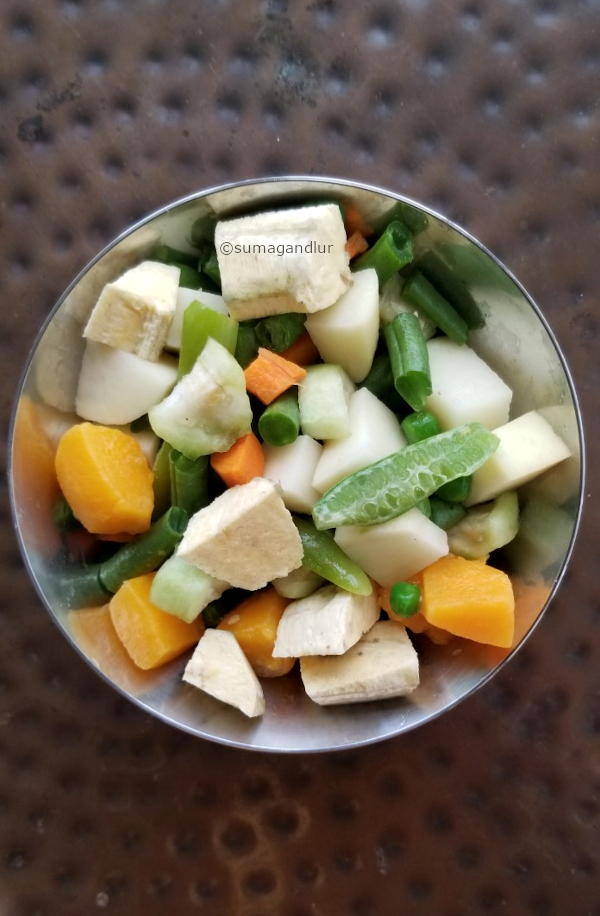
Most of the local variety vegetables on hand were originally used in this preparation as long as they are not the bitter / sour / tough variety. No onion or garlic is used in the recipe. Some of the local vegetables that go in this dish are bread fruit, tender / dried cashews, pumpkin, yam, ash gourd, bottle gourd, ivy gourd, ridge gourd, snake gourd, yard long beans, plantain, the yellow colored cucumber, and sweet potato. I used carrots, beans, potatoes, green peas, butternut squash, ivy gourd, ridge gourd and plantain for my yogiratna / valval. 

Fresh or frozen coconut can be used to prepare coconut milk. If using frozen coconut, thaw it before using. The coconut is ground with water twice to get the first time 'thick' milk and the second time 'thinner milk'. Usually the vegetables are cooked in the thin coconut milk and water mixture in a pot. I made a small portion and pressure cooked them in water. Yogiratna / valval needs to be slightly on a thicker side (and so avoid cooking vegetables in water more than needed or throw away / save the extra water.) Mixed vegetables and coconut milk can be used in an average 1:1 ratio in the recipe. 

Ingredients:
1 cup mixed vegetables, chopped *
2 - 3 green chilies, sliced
1/2 cup shredded coconut / 1 cup coconut milk
1 tsp. rice flour / all purpose flour
Salt to taste
Ingredients for seasoning:
1 tsp. ghee
1/2 tsp. mustard seeds
1/2 tsp. cumin seeds
Few curry leaves

* I used carrots, beans, potatoes, green peas, pumpkin, ivy gourd, ridge gourd and plantain.

Directions:
* Pressure cook the prepared vegetables along with green chilies for one whistle, adding about 1/2 cup of water.
* If preparing coconut milk from scratch, grind the coconut adding about a cup of water. Pass the ground coconut mixture through a sieve and collect the thick milk. Add the coconut residue back to the blender and add about 1/4 cup of water and grind again for few seconds and collect the thin milk. (The milk extracted this time will be thinner than the one extracted the first time.)
* Combine flour and the thin coconut milk in a small cup and mix well. 
* Add the cooked vegetables, the thin coconut milk - flour slurry, and salt to a pan. Cook for 2 or 3 minutes. Add the thick coconut milk and bring the mixture to a boil. Lower the heat once the mixture starts boiling and simmer it for about four to five minutes. Turn off the stove. (I added both the coconut milks at the same time.)
* Heat ghee in a small pan and add mustard seeds and cumin seeds. When mustard seeds start to splutter and cumin seeds turn a shade darker, add curry leaves and turn off the stove. 
* Add this seasoning to the above cooked vegetable mixture and stir well. Serve warm with rice.

So far in my 'A - Z' Karnataka Recipe Series,
Akki Halbai
Biscuit Roti
Congress Kadalekayi
Davanagere Benne Dose

Wednesday, November 11, 2020

Instant Appam

I had made these instant appam for my Kerala breakfast platter that was a part of 'Thaalis & Platters' that I posted during September. Idiyappam was originally on my mind when I thought of that platter but decided to include another dish at the last moment. These appams that I found on YouTube came to my rescue (I however forgot to note the link.) which are an instant version. Unlike the traditional version appam posted here, this appam batter does not include any yeast and needs no fermentation overnight though the batter needs to rest for a short amount of time. The instant appam batter instead has an unusual addition of fruit salt that is not typically used in south Indian cooking which make these appam softer and fluffier. These appam make a great breakfast / brunch item on a weekend or even during weekdays if one doesn't mind the short resting period of the batter.
Traditional appam are pancakes / dosas prepared with a fermented batter of rice and coconut and are popular in the south Indian states of Kerala and Tamil Nadu. The appam are bland on their own and are usually served with a savory condiment / side dish. These thin breakfast pancakes are typically bowl shaped since they are made in appachatti, a cast iron frying pan that is rounded at the sides and looks like a shallow bowl. I followed the recipe exactly including making them on a griddle instead of a curved pan similar to a wok and so these don't have the typical appam shape. Also they were made thicker. I had served them with kurma and kaara chutney.
Ingredients:
2 cups rice flour
1/2 cup cooked rice
1/2 cup shredded coconut, fresh or frozen
Salt to taste
1 tsp. sugar
1 to 1.5 tbsp. Eno's fruit salt
Oil to make appam

Directions:
* Thaw coconut if using frozen. Grind rice flour, rice, coconut, salt and sugar together into a smooth batter of pourable consistency, adding water as needed. (One may need about 2.5 cups of water.) 
* Pour the batter into a container, cover and let the batter sit for at least half an hour. (I let it to rest for a couple of hours.) Add any extra water if needed at this point.
* Add fruit salt 
just before making dosas and sprinkle a tbsp. of water over it. 
* Mix gently to combine, yielding a frothy mixture.
* Heat a griddle / tawa and pour a ladleful of batter at the center and don't spread it. 
* Add a tsp. of oil around the edges and when the appam appears dry  on the surface, flip it.
* Cook for few more seconds until the bottom side gets cooked as well and transfer the appam onto a plate using a spatula.
* Repeat the steps of making appam with the remaining batter.
* Serve them warm with a side dish.

Sunday, October 18, 2020

Navaratri Naivedya ~ Sihi Dose / Bellada Dose

Sihi dose / Bellada dose which literally means a sweet pancake or a jaggery pancake is a traditional recipe from Karnataka. These are prepared during Dasara / Navaratri, especially on 'Sarawathi Pooje' day to offer as neivedya. These dosas are made with a ground batter of rice, jaggery, coconut and cardamom. A tsp. or two of poppy seeds can also be used in the recipe. If using them, they are soaked along with rice and ground. There is also another version of sweet dosas in south India which is wheat flour based. These sihi dose are usually made smaller in size compared to the regular dose / dosas. They are not cloyingly sweet and so one can enjoy 2 or 3 dose with no problem. 

The festive display of dolls and figurines arranged in tiers is a special feature of Dasara in south Indian regions. I am not sure about other places but it was a custom during olden days where I grew up that kids would visit homes in their neighborhoods, even strangers' during the time to see this arrangement. The kids usually got a simple treat from each home they visited. Some would prepare these dose in mini sizes and give them out to the kids who visited their homes.

Ingredients: (Yield around 16 dose)
1 cup rice
3/4 to 1 cup fresh / frozen shredded coconut 
3/4 tp 1 cup jaggery (depending upon the sweetness of jaggery.)
2 cardamom pods
Ghee to make dose

Prep work:
* Rinse and soak rice in water for about 2 or 3 hours. Drain the water after soaking period.
* Thaw if using frozen coconut by heating it in a microwave for about a minute.
* The jaggery can be directly used in the recipe if it is clean. If the jaggery has any impurities, add a little water and heat it. Turn off the stove and run the jaggery water through a strainer and collect the clean liquid. (Brown sugar can be substituted for jaggery.)
* Powder the cardamom seeds finely and keep aside.

Directions:
* Add the drained rice, coconut, jaggery or the jaggery water and cardamom powder to a mixer / grinder. Grind the mixture finely to a pancake batter consistency, adding little water if needed.
* Heat a pan and pour a ladleful of batter and spread it a little to keep it slightly on a thicker side. (One can make it thinly as regular dosas if preferred but they are usually made in a smaller size.) Pour 1/4 tsp. ghee around the edges and cook until the surface is no longer wet looking. Flip and add another 1/4 tsp. ghee around the edges if preferred. Cook until the other side cooks as well. Remove it and repeat the steps to make more dose with the remaining batter.

Monday, August 10, 2020

A - Z Karnataka Recipe Series ~ S for Sajjige Rotti

So far in my 'A - Z' Karnataka Recipe Series,
Akki Halbai
Biscuit Roti
Congress Kadalekayi
Davanagere Benne Dose
Ellu Pajji
Field Beans / Avarekalu Payasa
Girmit
Hitakida Avarekalu Huli
Iyengar Bakery Style Masala Toast
Jolada Vade
Kumbalakayi Idli
Limbe Hannina Gojju
Mysore Pak
Nuchinunde
Oodhalina Bisibele Bhath
Welcome back on this culinary journey across the state of Karnataka. My first choice for today's letter was sakkare achchu, the sugar figurines which are associated with the harvest festival in the region, Sankranthi. I was planning to visit India this summer and this achchu making was on the cards for the marathon. Achu making requires expertise and patience and I was planning to reacquaint with the process along with my mother who has stopped making them in the recent years. Unfortunately, the trip and the achchu did not happen for the obvious reasons. Going by the chaos happening around right now, this should be of least concern, I know.😟

I chose to go with something made with sajjige aka semolina and so here are some sajjige rotti if one is looking for some filling, tasty and healthy breakfast ideas. A rotti conjures up an image of thick and sometimes crisp flat breads which are a very popular breakfast choice in Karnataka. They can be made with rice flour and finger millet aka ragi flour which are the most common ones served for breakfast. Then there is jola/sorghum based flour ones which are a routine lunch item in North Karnataka homes. 

Today's semolina rotti aka rave or sajjige rotti is slightly different than those and can can be made in two ways. One is where a firm dough is prepared like the akki masaale rotti or the ragi ones and patted on the griddle and toasted. Or a thick batter is prepared with a similar consistency to idli batter and are prepared as thick dosas. However they do not have any resemblance to another popular version of  semolina pancakes in south India called the rava dosa either in texture or taste. They take a little longer to cook than the regular dosas and make an instant, no ferment dosas though the semolina needs to be soaked in yogurt for a short time. I make dosas sometimes adding turmeric as well and so there are both yellow and brown colored rottis pictured here.

Some other 'S' Dishes of the region:
* Sabbakki payasa - Tapioca pearl kheer
* Sajjappa - A festive dish with a sweet filling of coconut and semolina.
* Shaavige payasa - Vermicelli kheer
* Sukkinunde - Stuffed and fried sweet dumplings
* Shenga holige - Peanut poli
* Saasive - A raita prepared with a paste of coconut and mustard seeds with a tempering of spices. 
* Shenga hindi - North Karnataka style peanut powder
* Saaru - Rasam
* Saarina pudi - Rasam powder
* 'Sandige' aka sun-dried vadi 
* Sandige huli - A gravy made with steamed lentil dumplings
* The 'Set dose' which is served as a stack of three thick, spongy dosas served with vegetable saagu and coconut chutney. 
* Shaavige bhath / uppittu - Vermicelli upma
* The savory and sweet versions of 'Surnoli', dose / pancake from the Konkan region. 
* Southekayi rotti - Flat breads made with rice flour and cucumber
* Susla / Sushila - A puffed rice based snack from North Karnataka.
* Dishes made with the following vegetables would also fall under 'S' category. 

'S' kitchen ingredients / produce in Kannada:
* Sabsige soppu  aka dill leaves which is a commonly used greens in the region. 
* Soppu in general means greens. 
* Seeme badanekayi - chayote / chow chow
* Southekayi - cucumber. 
* Sorekayi - bottle gourd 
* Shunti - ginger
* Suvarna gadde - elephant yam / suran
* Sapota hannu - chikoo fruit
* Sebu or sebina hannu - apple
* Seebe hannu - guava
* Seethaphala - custard apple
* Saame - little millet
* Sakkare - sugar
* Sabbakki - sago, tapioca pearls
* Sajje - pearl millet / bajra
* Sasive / Sasive kaalu - mustard seeds
* Sihi - sweet
* Siri dhanya - millets
* Shavige - vermicelli
Ingredients: (Yield 8 dosas)
1 cup semolina
3/4 cup yogurt
3/4 cup water
Salt to taste
1 tsp. cumin seeds
2 pinches of asafoetida powder
2 pinches of turmeric powder (optional)
2 sprigs of curry leaves, finely chopped
A handful cilantro leaves, finely chopped
2 green chilies, finely chopped
1 tsp. ginger finely chopped
A handful of fresh / frozen grated coconut
Ghee / oil to make dosas

Directions:
* Combine semolina and salt in a bowl. Add yogurt and water to it and mix well. Leave it aside for at least 15 to 30 minutes.
* If using frozen coconut, thaw it in the microwave before adding it to the batter.
 * Add the remaining ingredients except the ghee / oil to semolina bowl and mix well.
* Heat a tawa / shallow pan on medium pan. Sprinkle a little water on the pan to check whether the pan is ready to make rotti. It is ready if the water sizzles and evaporates immediately. If not, heat the pan some more but don't bring it to a smoking point. 
* Pour a ladleful of batter at the center. Spread it as thin as possible. The traditional way is to spread the batter thickly using fingertips.  A ladle can be used instead to be on a safer side though these can not be spread as thinly as the regular dosa.

* Pour a 1/2 tsp. oil / ghee around the edges and cook until the batter appears dry on the surface, around 2 minutes and flip. Cook the other side as well for about a minute and remove the dosa with a spatula.
* Repeat the rotti making with the remaining batter and serve warm with a chutney.


Comments